Preface
Before launching a project, what is the very first thing to do besides analyzing requirements? In my opinion, it is asking, “Is it worth doing?” And answering “Is it worth doing?” requires a wealth of experience as backing—not only seeing how much return success can bring, but also predicting how much will be lost in case of failure.
Take tech stack migration as an example. Suppose your company has been acquired by an industry leader. To fully align and harmonize the entire tech stack between the group and your company, 6 months must be spent ALL IN on tech stack migration: 1 month traveling to discuss requirements and align end-to-end flows, 1 month on detailed domain designs, 2 months on development, 1 month on end-to-end testing, 1 month establishing dual-write paths, writing data migration scripts, setting up monitoring, and conducting bidirectional data checks to ensure stability, 3 months continuously rolling out canary traffic with back-and-forth rehearsals (if things don’t go smoothly, switching long-tail traffic might take over a year to finish), and 1 month deprecating the legacy pipeline. Although the last 4 months mostly consist of bug fixing, toggling canary switches, and taking on new requirements, can the labor, time, and opportunity costs invested in the tech stack migration be recovered quickly in the subsequent period? If competitors come up with new tricks during the initial 6-month pause, will it cause market share to enter a “death spiral” shrinkage? If your company gets spun off from the group later on, what would be the return on another 6 months of migration work?
Lately, I’ve been obsessed with watching the bankruptcy-niche content creator “Attack of Shen Shuaibo”. While enjoying the entertainment, I’ve also been observing why over-investing in various projects leads to blown-up ROIs and turns them into case studies in bankruptcy videos.
This is a note-taking blog post. As the saying goes, “the palest ink is better than the best memory.” Since I tend to forget a book as soon as I read it, it’s better to keep diligent records. I will weave my insights into the notes using annotations, though some sections are relatively brief. Part of the content’s copyright belongs to “Yitang”, a startup bootcamp packed with practical knowledge.
ROI
Whether one’s ability to evaluate ROI is up to standard serves as a benchmark for whether an excellent lead passes muster.
Narrow ROI refers to Return on Investment. Common formulas include GMV/Cost spent (for instance, new customer acquisition = 14-day revenue / paid customer acquisition cost).
Broad ROI means considering whether the return-to-investment ratio is worthwhile before making any complex decision. This decision factor is not a simple financial metric and cannot even be quantified into numbers; it consists of vague decision dimensions used to determine whether to do it or not.
The number of broad ROI decisions is tens or hundreds of times that of narrow ROI decisions.
From Confusion to Proficiency
ROI needs to be thoroughly considered, taking into account all options from a global perspective.
- Operational cost
- R&D cost
- Opportunity cost (If these resources were used for other things, could they earn more?)
- How to strive to increase R and decrease I (cost reduction and efficiency enhancement)
Step 1: Deconstruct input/output elements
Step 2: Estimate and find key values
Step 3: Calculate ROI
ROI Evaluation Models
Approaching things with an ROI mindset makes one rational, scientific, and confident. ROI is not just a high-sounding business term; it can actually be applied to all aspects of life—it is simply a mindset for making choices.
A high-quality ROI evaluation should consider three dimensions:
- Width: Relatively comprehensive gains and costs, taken into account as completely as possible.
- Depth: Relatively concrete, or even quantitative, evaluations rather than generalities.
- Height: Considering company value and long-term value, as well as opportunity costs and time windows.
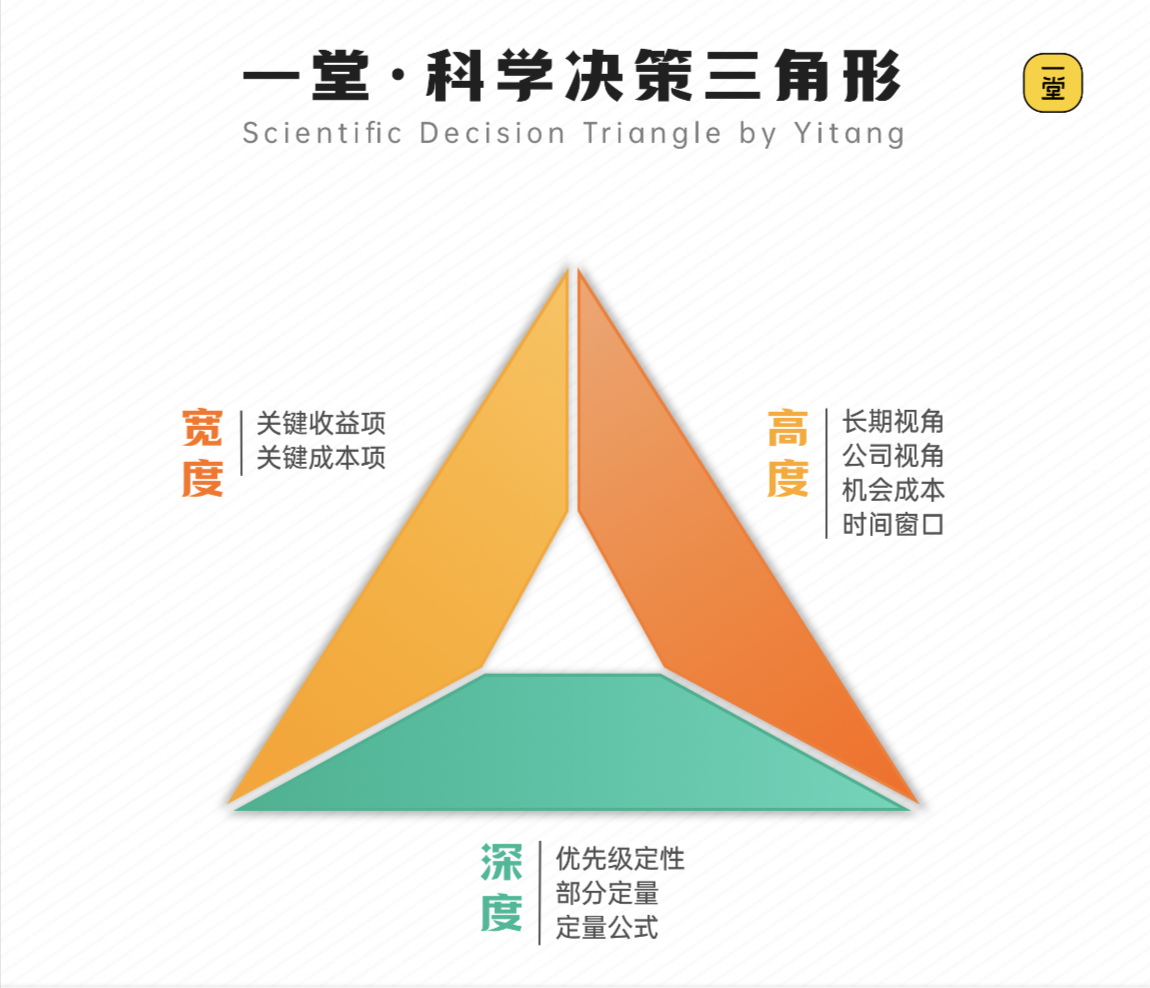
Increasing Width
Comprehensively identify value and pull out all key items to avoid misunderstandings and misjudgments.
When faced with important matters, break the habit of making snap judgments. Don’t rush into decisions—slow down the process by a beat and clearly list the key value and return items.
In fact, in more than half of cases, it’s simply a matter of not having written things down carefully; once clearly listed, the answer naturally takes shape.
Increasing Depth
Many times, our hesitation stems from a lack of analytical depth.
There are 5 levels of evaluation depth:
- Snap judgment: Virtually no evaluation; decided based on intuition.
- Qualitative prioritization: Simple qualitative analysis and setting priorities.
- Partial quantification: Attempting to quantitatively describe important elements.
- Quantitative formula: Strict formulas, striving for quantification.
- Strict financial ROI: Financial ROI in its narrowest, most precise sense, accurately calculated.
To summarize:
- For unimportant decisions, making a snap judgment isn’t a big problem.
- If caution is needed, try listing key items and setting priorities.
- If a decision is important and you hesitate, try quantifying key items to help make a judgment.
- If it is important and you still hesitate, consider turning it into a strict quantitative formula or even a financial ROI calculation.
In short, the depth of your ROI estimation should strive to match the importance and difficulty of the decision.
Increasing Height
More complex decisions require considering four new perspectives: long-term perspective, company perspective, opportunity cost, and time window.
Long-term perspective: Team growth, habit formation, continuous returns, compound interest, and other factors.
Company perspective: Core competencies, moats, cash flow, key risks, fundraising plans, branding, and related issues.
Opportunity cost: Consider whether allocating these resources elsewhere would yield a higher ROI.
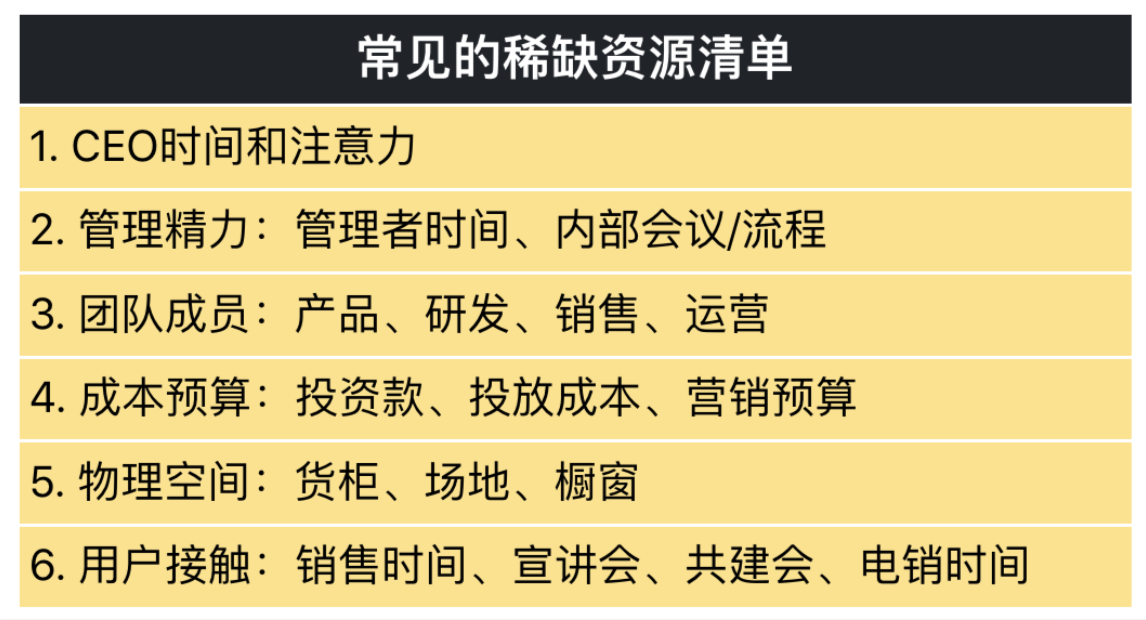
Reflection: Currently focusing on A, if an opportunity B arises, under what circumstances should some resources be invested in B? If there are four major channels ABCD with ROIs of A>>B>C>D, under what circumstances should resources be allocated to B?
Judge based on the time window:
Defensive investment — B is currently easier to launch, and might even impact core business A in the future.
Opportunity-driven investment — A remains effective in the long run, but B presents a time-limited window that won’t exist if missed.
Therefore, one needs to elevate from an internal perspective to an external perspective.
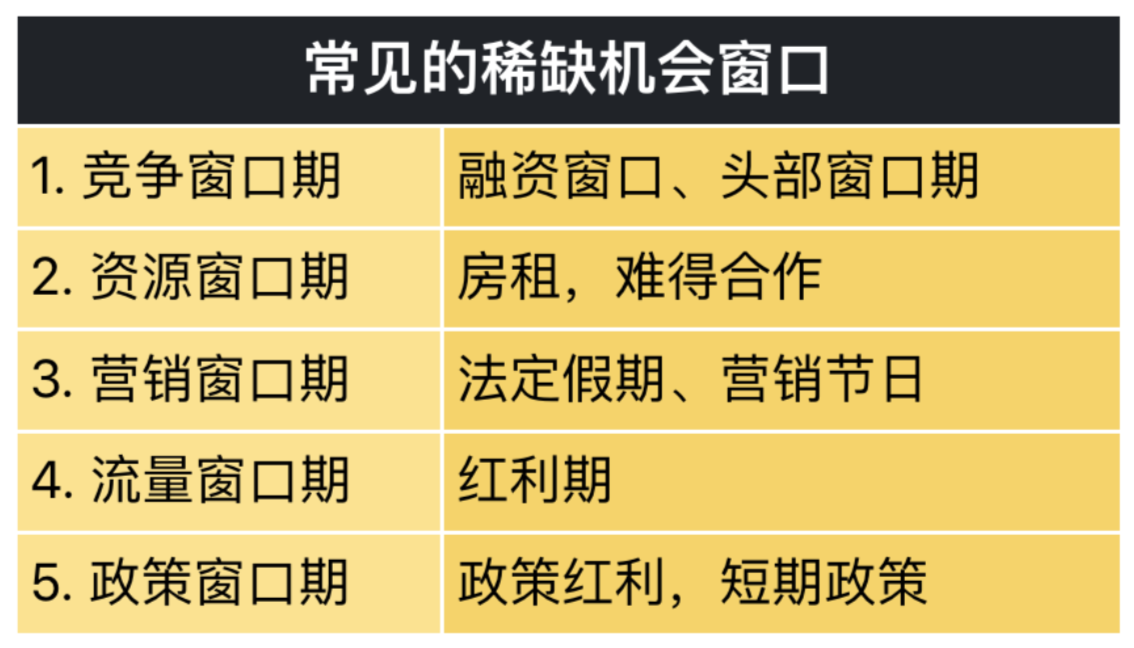
Baidu Waimai gave this a thumbs up
The core decision is really about figuring out: Should we do this thing right now?
Three important dimensions: ROI (Return on Investment), Opportunity Cost, Opportunity Window.
- ROI: Is it worthwhile? Input VS Output
- Opportunity Cost: Is it optimal? This option VS All other options
- Opportunity Window: Is it now? Doing it now VS All other options
The Essence of Learning ROI
First level of understanding: Holistic thinking
Ask a few more rounds: “Is there anything else?”
Somewhat similar to the 5 Whys method
Second level of understanding: Trusting predictions
If it is predicted to be viable, it may still have a high probability of failing; but if it is deemed unviable even under optimistic predictions, then it is overwhelmingly likely to be infeasible.
Most ROIs do not make sense in the early stages; having an ROI model provides a ruler and scale to calibrate. Without an ROI, you might not even have anything to adjust.
Third level of understanding: Mastering the fundamentals
Inability to discuss business on equal terms may surface as organizational or writing issues, but the root cause often lies in misaligned ROI evaluation capabilities among team members.
If two people share a consistent evaluation model and differ only in parameters and priorities, they simply need to exchange information quickly, assemble the evaluation model together, and reach a conclusion—the process is extremely fast and efficient.
Systemic stability is more important than decision quality
When I make decisions, I want to expose the process to everyone for mutual reference and discussion; when you make decisions—especially important ones—you must accept my challenges and questioning.
As a business lead, you have the duty to clarify your business logic; as the boss, I have the duty to explain my key decisions and allow you to question them.
ROI is the best means to reach a team consensus.